Walther Dreher
|
Intercultural Roots
Part I:
Dr. Chikuro Hiroike. Personal Reflections on Hidden Traces, Spiritual Relatedness and Future-Path-Seraching Efforts
Motto
Thomas Stearns Eliot:
“Old men ought to be explorers. Here and there does not matter. We must be still and still moving into another intensity. For a further union, a deeper communion…”
Motto
transformed:
“Young man must be explorers. The task they stand for matters. They have to understand: Irruption of time manifests through intensity. Connectedness, participation, being in-between, transforming our consciousness are the features of our time.”
Bearing in mind
Old man and woman, young man and woman
are free to be or to become
explorers for ...
How it happened.
It was last year summer, after it was again possible to enter Japan, we made our first journey after three years. I wanted to take the chance to meet President Hiroike Motototaka to thank him for all what is in my life connected with the Hiroike Gakuen and to exchange some thoughts.
Completely unexpected, the President surprisingly honoured me with a Visiting Professorship.
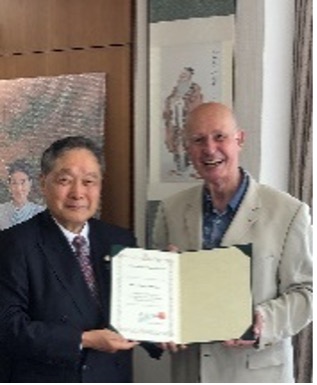
In the office of President Hiroike, Mototaka
May 2022
The travel this coming spring allows me to deliver my promise for such a task. And – as more than 50 years ago – this coming together resembles for me the Kenkyubu-meetings more than five decades ago.
While looking on a half a Century Life-intensity the following theme came up somehow of its own volition:
“‘Believing in Providence; Attaining Wisdom and Peace of Mind
Discerning the Law of the Universe; becoming Selfless,
It is not I who do this: It is the will of God’
Dr. Chikuro Hiroike
Personal Reflections on Hidden Traces,
‘Spiritual-Relatedness’ and ‘Future-Path-Searching efforts.”
Since my time of being a primary school teacher in the 1960th I like to use pictures, or stories, or associations and other imaginative motives to view to things and talk to about them with others. Therefore, I also use here such ‘material’ for different point of views.
The first one is a painting of Paul Klee, Main path and byways, which animates to walk on it, experiencing single Segments and the flow of the whole towards an anticipated horizon.
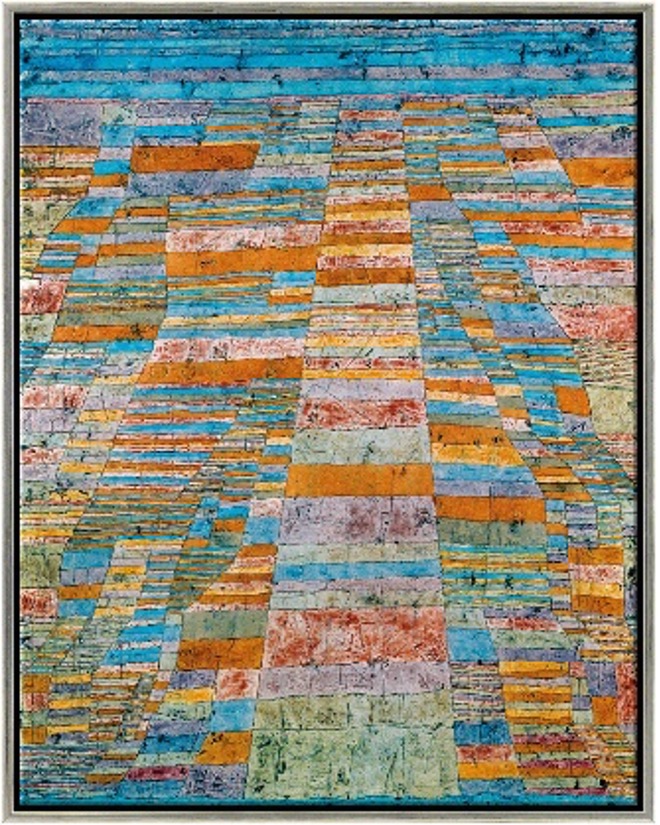
Paul Klee, Main path and byways, 1929
Chikuro Hiroike:
Believing in Providence, Attaining Wisdom and Peace of Mind.
Discerning the Law of the Universe; becoming Selfless,
It is not I who do this: It is the will of God’
and an addition from
Joseph Jakworski:
“…everyone is born with a destiny or a purpose, and the journey is to find it.”
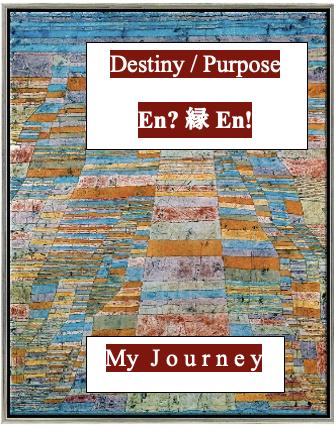
Therefore I ‘use’ this painting as a ‘colourful frame’ as a retrospective and prospective view of my own path of life.
But there are special views to take:
From Distance
‘Tooku kara…’
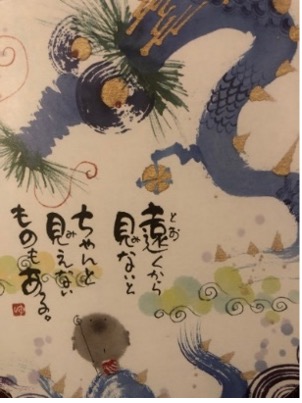
In a perpetual calender with Miki Yusekis paintings - 遠くから見ないと見えないものがある – I found this picture. I like this painting for two reasons: First it reminds me to my Animal-Cycle, Tatsu. And secondly it symbolizes another ‘per-spective’ to look on things.
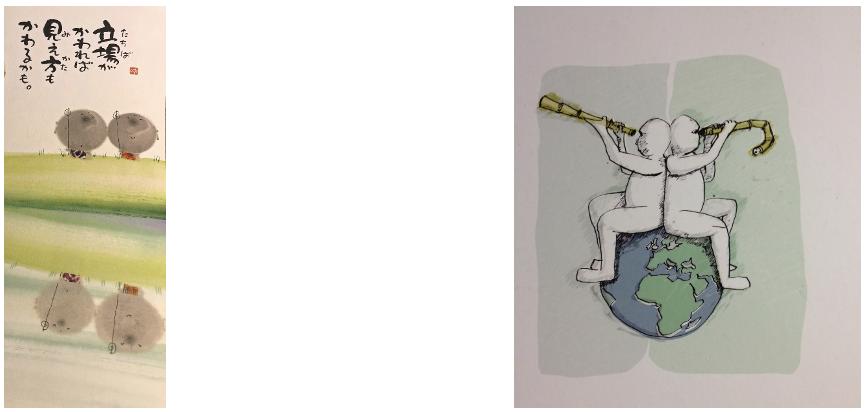
The Journey
Path-Segments as Traces on the Way
Path-Segment: Coming to the world
“…my body emerged onto this Earth at the same time as the emergence of…” (Sara King)
(Fragmented perceptions)
Path-Segment
Traces of Living in the Hiroike Gakuen
When I’m look back it feels as if birds are flying in the evening backwards to their sleeping tree for recovering after a long day, a long life.
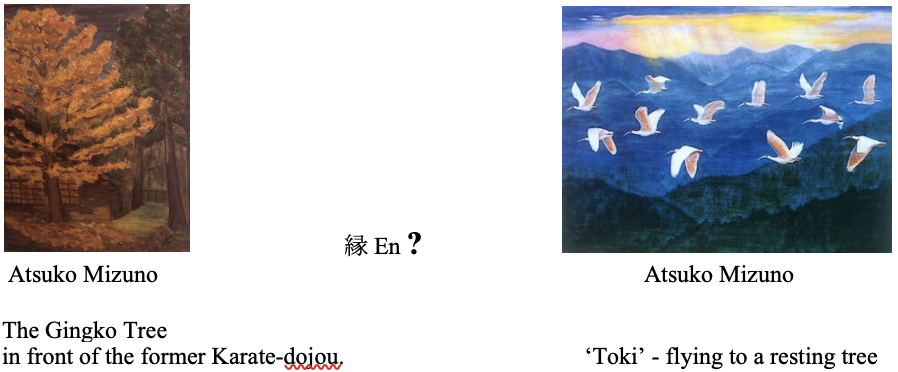
A few Impressions
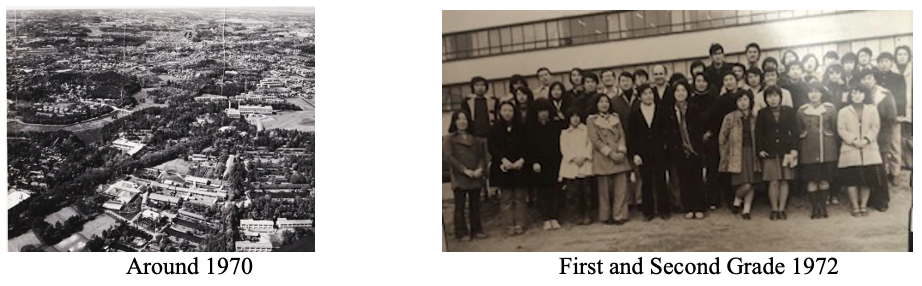
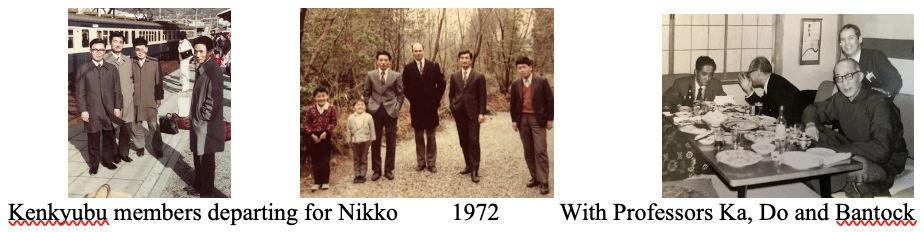
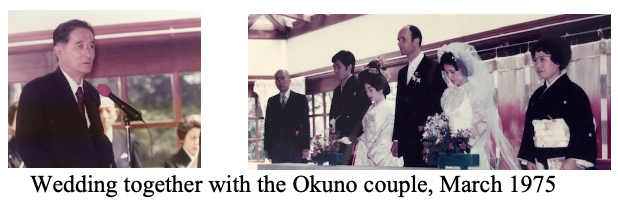
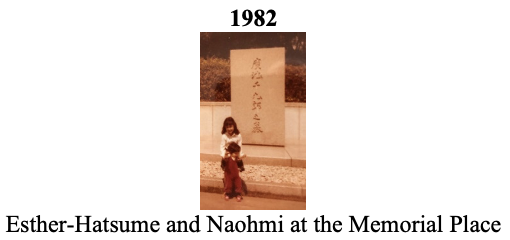
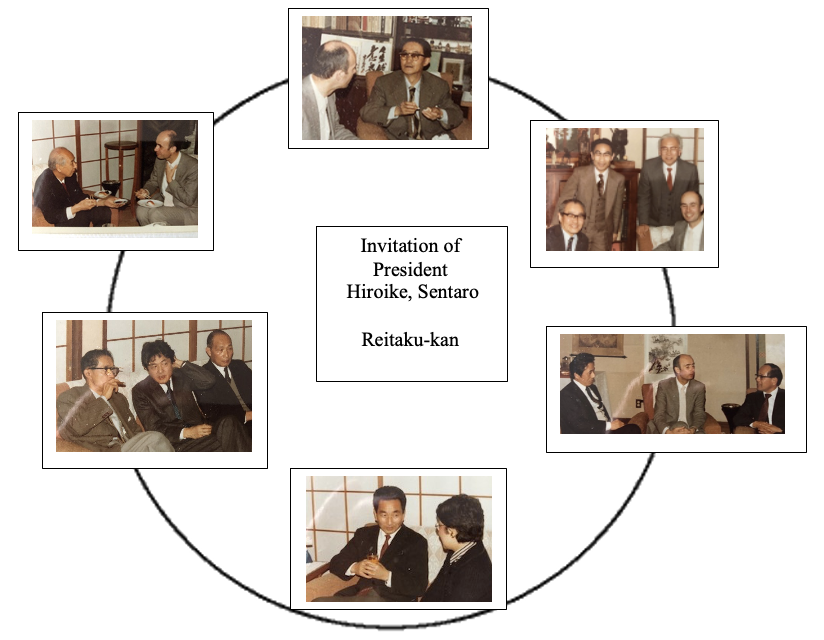
Reflections on my Living in this Exceptional Place:
‘Hiroike Gakuen’
Dr. Hiroike
Relatedness
When I speak of ‘Relatedness’ then this Awareness wasn’t given to me from the beginning. It was a slowly unsealing of a ‘seal’ which my life locked.
Was this the challenge for Hiroike, Chikuro: To connect or bridge what is expressed in the three quotations of the theme ‘Providence - Law of Universe – God’, through his ‘scientific path-searching efforts’?
In 1971 – it was in summer terms vacation – I travelled to Kyushu and in a quite adventurous Taxi drive I succeeded in finding Dr. Hiroikes Place of Birth in Nakatsu. When starting to read his biography I noticed that be became teacher at the age of 19.
I felt close to the sprouting seeds of his youth towards ‘Education’, somehow ‘related’ and that he was moved by the same question of Walther von der Vogelweide (12th Century) or Johann Heinrich Pestalozzi (18th Century).
Walther von der Vogelweide in his poeme ‚I set upon a rock’ was thinking about the question “…how one should lead one’s life on earth. There was no counsel I could give…”
(https://lyricstranslate.com/de/ich-saz-uf-eime-steine-reichsklage-i-sat-upon-rock.html)
And Johann Heinrich Pestalozzi asks in his treatise ‘Evening hour of a Hermit’ (Abendstunde eines Einsiedlers):
“Man, sitting on a throne or in the shadow of a canopy of leaves is equal: Man in his essential being, what is he/who is he? Why doesn’t the sages tell us? Why aren’t the illustrious Thinkers/Spirits aware, what their lineages might be? Does a farmer work with his ox without knowing him? Doesn’t a shepherd quest the nature of his sheep? In the essential Being, what is Man?” („Der Mensch, so wie er auf dem Throne und im Schatten des Laubdaches sich gleich ist: der Mensch in seinem Wesen, was ist er? Warum sagen's die Weisen uns nicht? Warum nehmen die erhabenen Geister nicht wahr, was ihr Geschlecht sei? Braucht auch ein Bauer seinen Ochsen und lernt ihn nicht kennen! Forscht ein Hirt nicht nach der Natur seiner Schafe!
In seinem Wesen, der Mensch, was ist er.“
https://www.heinrich-pestalozzi.de/biographie/tabellarische-uebersicht/abendstunde-volltext).
“Man in his essential being, what is he/who is he?”
Ryochi Ochia in the German Publication ‘Moralogie’ succeeded in combining together the manifold impulses of Hiroike as an exceptional Thinker, Leader and Transformer. I am thankful for his contribution which comes more consciously in my attention. – besides, that the Book in German helps me immensely in following differently argumentations of Hiroike.
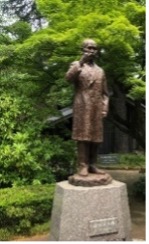
The statue in the Hiroike Gakuen express Hiroikes strength of confidence about the ‘Sources’ he chose for becoming guidelines of his personal and mankind-oriented path.
Ryoichi Ochia underlines that Hiroikes time School subjects have been mostly scientific based – therefore Moral studies have too. When I stayed in the Gakuen, this was often theme of our kenkyubu study group.
My ‘feeling’ from 1971 – the first year was a ‘dreamlike being arrived’ at a special place on my journey – can be expressed:
“A place to live which bridges ‘Heavenly Sources’ -the Wisdom of the Sages - and ‘Earthen Soil’ – cultivated by men of Supreme Morality and which individual, social und humanitarian culture.”
Are these words too enthusiastic, even quixotic?
What happened after 1975?
My way continued mysteriously. It has been just after the New Year days 1974, that Professor Kitagawa accompanied me to the Asahide Gakuen.
This encounter was the base to meet – ‘just by chance’ (?) - a former fellow student in March 1974 in Tokyo who offered me for 1975 an academic post at the University of Cologne where I started with the summer term in the Faculty of Special Education and the field of ‘Education for Mentally and Severely and Multiply Retarded People’.
So, there was no smooth switchover from the years in Japan to such a marginal experience. And also, out of my University Studies I wasn’t specially prepared for this task.
But what I brought with me from these four years living in the Gakuen was the treasure of living in an ‘interpersonal rich and extraordinary Human Community’ under guiding principles derived from ‘Sages of the World’.
For quite a long time this treasure seemed to be hidden, id est, also the deeper Spiritual Stream emanating out of Hiroikes Work.
In my native country South Germany one can experience such a phenomenon quite obviously in nature. It’s the percolation of the river Danube. In dry summers it happens that the water stream disappears. As a boy I was often walking in this dried river bed.

My life, occupied by so many new tasks and experiences didn’t force me to think back philosophically to Hiroikes efforts. But maybe also, because for Hiroikes specific approach there was no space in my coming academic surrounding and the ‘spiritual stream seeped away.
Path-Segment: ‘Special Education’ - University of Cologne
When I started my ‘Path-Searching’ in Special Education I wasn’t an experienced Special Educator and Scientist. What I brought with me was Research in a ‘double sciene’ Psychosomatic Medicine and basic ideas of ‘Anthropological Questioning’ as my academic teacher and Doctor Father Otto Friedrich Bollnow introduced.
Practically confronted with young people and adults ‘being kept’ in Psychiatric Clinics and by a medical doctor ‘defined’ as ‘person like a stone’ while showing us the different section in the Clinic evoked in me confrontation and helplessness at the same time.
The late Aron Ronald Bodenheimer, Psychiatrist, helped me strongly to find a new way through what he called ‘Elements of Relationship’ (Elemente der Beziehung). And also, Maurice Merleau Pontys Phenomenology was a helpful guideline.
Therefore, for me - at the beginning of my special educational academic work - came the encounter with Jean Gebser in the right moment, though I couldn’t realize “spontaneously” what turning point happened in my life.
Already in 1978, I heard Jean Gebsers name and was acquainted with his main work ‘Ursprung und Gegenwart’ (The Ever-Present Origin). In different publications I tried to show what kind of unexpected questions the mutations of consciousness let us now. But my efforts didn’t find sufficient answers and I didn’t get much, or better to say, no attention.
In the 1990th also started a close, more than 10 years cooperation with colleagues from the National Institute of Special Education Japan: Professors Ochiai, Toshiro, Sasamoto, Ken, Takisaka, Shinichiro and Kono, Tetsuya. Mrs. Prof Oda, Miki joined the group during her stay at the University of Cologne. One very special experience was the ‘bodyoriented’ approach to multiply and severely mentally impaired children and youth: The Dohsa-Method (Softtouching)
In the 1990th the European Union lunched academic projects under the Name of ERASMUS and TEMPUS. Different international cooperations developed under the goal of Inclusion. A variety of academic approaches met in the participating international groups, but there was no real questioning about epistemological backgrounds. For example, Pestalozzi wasn’t ‘in’!
But looking to this phase as a whole, Gebser didn’t ‘decipher’ really. Still, I wasn’t prepared to grasp what was hidden in it. But my attitude towards man and the surrounding somehow were transforming – unconsciously.
Later I tried to combine perspectives in a presentation in Japan on a Congress, but I think I overstrained the audience (Compare: “One thing I’ll never do: To give up” https://www.genius-for-all.de/florilegium.php), because I couldn’t ‘translate’ what I intended to express.
Path-Segment: Jean Gebser, ‘The Ever-Present Origin’
In the frame of this meeting with all of you, I do not intend to make an introduction to Jean Gebser. One can find a very good introduction here:
https://aaron-cheak.squarespace.com/from-poetry-to-kulturphilosophie
http://www.aaroncheak.com/jean-gebser
as well as Jeremy Johnson, Seeing through the world, Jean Gebser and Integral Consciousness, 2019, look further down,
and also, on my – not well developed and maintained -Website:
www.genius-for-all.de
Only one connection may be underlined which touches the Relatedness of me to Hiroike and of him to the Sages. Jena Gebser writes at the beginning about Fundamental Considerations:
“The present book is…the account of the nascence of a new world and a new consciousness. It is based not on ideas or speculations but on insights into mankind’s mutations from its primordial beginnings up to the present – on perhaps novel insights into the forms of consciousness manifest in the various epochs of mankind: insights into the powers behind their realization as manifest between origin and the present, and active in origin and the present. And as the origin before all time is the entirety of the very beginning, so too is the present the entirety of everything temporal and time-bound, including the effectual reality of all time phases: yesterday, today, tomorrow, and even the pre-temporal and timeless.”
Gebser specifies the ‘new consciousness’ as ‘’a-perspective’. “The aperspective consciousness structure is a consciousness of the whole, an integral consciousness encompassing all time and embracement both man’s distant past and his approaching future as a living present. The new spiritual attitude can take root only through an insightful process of intensive awareness. This attitude must emerge from its present concealment and latency and become effective, and thereby prepare the transparency of the world and man in which spirituality can manifest itself.” (Gebser, EPO, 1984, 1 ff.)
In this way also today in our meeting all is present what was half a century ago and much further back, what is now going on and what emerges out of the future. The transparency of man - of us - has to be prepared so that spirituality can manifest itself. But it’s also the transparency of the spirituality (das Geistige) which is in need of us. (See below, Theory U).
Path-Segment: Otto Scharmer, ‘Theory U’
Around 2000 it met Otto Scharmer. Three points I’d like to accentuate:
1. Three divides
Scharmer emancipated me from the exceptional view of handicapped persons as people on the edge of our theories and practices, when I got slowly insight into the dependency three general divides: The ecological, the social and the cultural-spiritual.
• The Ecological Divide exists because of a disconnect between self and nature.
• The Social Divide arises from a disconnect between self and other.
• The Cultural-Spiritual Divide arises because of the disconnect between self and Self
The last divide opens another relatedness to Chikuro Hiroikes’ understanding of the ‘self’ in common morality and the Self with the capital S in ‘Supreme Morality).
2. A New Science
Well known for his leadership activities Scharmer mentions, that Theory U “is intended to do more than just illuminate a blind spot of leadership. Rather, it seeks to uncover a hidden dimension in the social process that each of us encounters in our everyday life, moment to moment. To do this, we need to advance our current form of science. As the psychologist Eleanor Rosch from the University of California at Berkeley likes to put it, ‘Science needs to be performed with the mind of wisdom.’ Science as we know it today may still be in its very infancy.”
And Scharmer is courageous enough to compare the situation today with a man at the transition to our modern era when he continues:
“The transition of science is no less revolutionary than Galileo Galilei’s. And the resistance from the incumbent knowledge holders will be no less fierce than the one that Galilei met in the Catholic Church. Yet, when looking at the global challenges of our time, we can recognize the call of our time to come up with a new synthesis among science, social change, and the evolution of self (or consciousness). While it has been a common practice for social scientists and management scholars to borrow their methods and paradigms from natural sciences such as physics, I think it is now time for social scientists to step out of the shadow and to establish an advanced social sciences methodology that integrates science (third-person view), social transformation (second-person view) and the evolution of self (first-person view) into a coherent framework of consciousness-based action research.” (Scharmer, Theory U, 2007, 14 ff.; the accentuations are done by me). This was for me revolutionary: Mind of Wisdom and Science.
3. The Power of Intention
Scharmer refers here to what we call ‘will’ – the third ‘instrument’ in addition to ‘mind and heart’ – an quotes Martin Buber:
“The philosopher Martin Buber made the distinction between two types of will: the small will, or one’s instinct, and the Grand Will, which is the future that needs us to come into reality. There is something deeply magical about tapping into our deeper creative force. It has to do with a different kind of energy economics… It functions on a simple principle:If you give all you have and all you are to your essential project, everything will be given to you…
This kind of creative or spiritual economics is at the heart of every profound innovation in science, business, and society.” (Scharmer, 2007, 412)
I mention this direction of ‘thinking’ because – as you may easily recognize – it touches the approach of Chikuro Hiroike. (Compare: Source https://www.genius-for-all.de/florilegium.php).
I’m sure that once again questions of Relatedness are given and want to be reflected. During my active academic work quite a big number of students tried in their papers or in Doctor thesis to approach what one may call a ‘turning point’ (Wendezeit): We are standing at a threshold. Just in the last year our Chancellor, Olaf Scholz; doesn’t get tired to talk about the turning of an Era” (Zeitenwende).
The background of it isn’t only the ‘outer’ world situation. The background shows to much deeper roots: There is a turning of an era which presages, as we hear, a new consciousness. Consequently, there must follow a new Being, new Attitudes towards the Earth and the Cosmos”.
Relating to the ‘GAIA-Movement I translate GAIA as acronym: Grounded Awakening of an Integral Awareness.
At the 2nd Moral Science International Conference 2009 I offered a paper with specific consideration of this Theory U (The book is meanwhile translated in 9 languages, including Japanese), but at that time the ‘dragon view’ wasn’t yet so ‘sharp’ as necessary.
Menawhile there exist a big world-wide ‘Theory U Community’, including Japan and its activities are impressive, effective and real mind-changing.
(For direct information: https://presencinginstitute.org/)
Path-Segment: Seeing through the World
Just in 2020 I discovered a vivid Community of Gebserians in the USA and a new space to breathe spiritually opened
(For direct information: https://www.nuralearning.com/).
Jeremy Johnsons offer in his course to read Jean Gebser (newest course just now running with the possibility of meetings three time a week. https://www.nuralearning.com/seeing-through-the-world) brought me to a completely new relationship with Gebser and my being here today is based on this fact.
And it’s not only the fact, but there is something emerging which seems to ‘blast’ the limitations of our well known mental-rational way of thinking and constructing our reality. I couldn’t imagine in 1978 when getting Gebser’s work for the first time in my hands how transmuting it will become.
Path-Segment: New tasks for the Moralogy Foundation?
President Hiroikes Message from 2022 states: “The Foundation changed its name from the Institute of Moralogy last year, and will celebrate its 100th anniversary in four years. The 21st century is not only the age of the mind, but also the ‘age of life.’ He asks for “continued understanding and support.” (Message of the President, 2022, https://eng.moralogy.jp/about/president/) By this the President encourages the understanding from outside and extending this might become possible through mutual connectedness of groups worldwide, finding con-tact with one another and supporting each other!
When I would have come today for the first time in my life – may be also 31 years old - to Japan and to the Hiroike Gakuen, whom and what would I meet?
2023
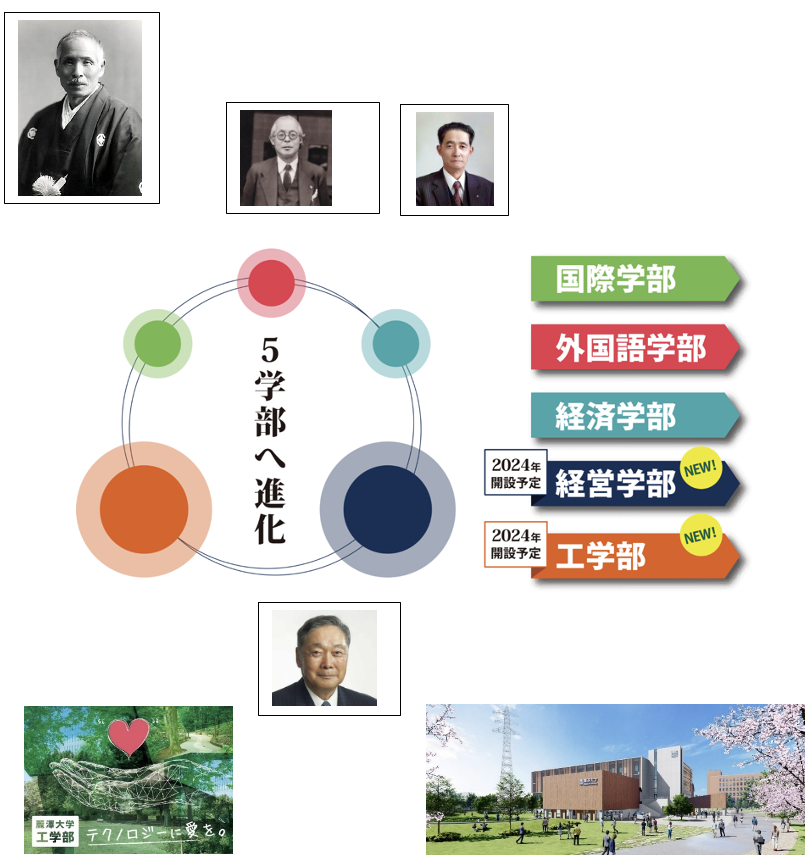
Two new Faculties with exclusive topics according to the understanding of man, mankind and our planet in the 21st Century.
What Hiroike Chikuro believed, researched and transmitted into the daily life – the eminence of the Sages and the sacrifice of human beings to follow and to shape new traces as realized in the Hiroike Gakuen – is still vivid and creating men and lives. During these last weeks the following thoughts came up. Hiroike, Chikuro while deeply immerging in the life and teachings of the Sages was driven by an analogue force like Gebser or Scharmer or Johnson – and surely many others too -, that the Human Being moves between the poles of ‘Transcendence and Immanence’; ‘believe’ and ‘scientific knowledge’ belong together.
Let me bring in this context – as one example of numerous of the Moralogy Foundations intentions and activities - the ‘Aims of the Research Center for Moral Science’:
“The Research Center for Moral Science is a research division that inherits the will of Chikuro Hiroike, the founder of the Moralogy Foundation. The center consists of seven sections (the Life and Environment Section, the Social Sciences Section, the Human Studies Section, the Education Section, the Chikuro Hiroike Studies Section, the History Section, and the Traditional Culture Section).
We conduct research activities with the aim of constructing a universal morality or a common morality that can be shared by all human beings, transcending religions and ideologies, from the perspective of moral science which is the study of the principles of the human spirit and social structure from a comprehensive standpoint, and the search for the values that human beings, society, and nations should have. The centre also works to create an international research network in ethics and morals by deepening exchanges with researchers and research institutions both inside and outside Japan.” (https://eng.moralogy.jp/research/) (Accentuation by myself).
1975 I was just fascinated about the questions the Kenkyubu-members at that time brought to every session, about the dialogic atmosphere, the integrity of the participants, the warmth of friendship.
In the Hiroike Gakuen ‘the mindset of bowing’ was born in my young German soul – and slowly perceiving my ‘silly question’ to Mr. Shindo, student from the English Department – As he showed me the place where he and Professor Bantock were practicing Kyudo – he naturally bowed upon entering the Dojou: ‘In front of whom or what do you bow? I asked.
2023 the Research Centre for Moral Science feels like an energetic taskforce – I would surely participate passionately in their Research like in the 1970th - and I wish the sections creative projects.
President Hiroike quoted above: The 21st century is not only the age of the mind, but also the ‘age of life’. Does it mean, we are responsible for ‘A new Culture of Mind and Life?’
(By the way, this connection of Mind and Life reminds me the work of the ‘Mind & Life Institute’ (https://www.mindandlife.org), of which one of the founders, the Tenzin Gyatso, the 14th Dalai Lama, was a guest of the Moralogy Foundation.)
And in addition, the following text, which I got ‘by chance’ these days from my USamerican Gebserian friend, Danie Hulett, – who, while talking, enthusiastically remembered her stay in Kyoto for half a year in 1960th to visit ‘all those temples’ -, and which may be a provoking base of mutual exchanges:
“From interview with Dr Sara King: (Neuroscientist, Medical Anthropologist, Political and Learning Scientist, Yoga and Meditation Teacher, Social Justice Innovator, Artist)
SK: I’m working right now with an organization called Mobius, and the purpose of Mobius is to steward the development of liberatory technology, or technology that is contributing to our sense of aliveness, our feeling of interdependence and well-being. I don’t find it be a coincidence at all that my body emerged onto this Earth at the same time as the emergence of the most recent technological revolution, like the personal home computer, video games.
All of these different forms of the internet, all of these emerged, I emerged, we emerged at the same time, and I noticed that many different things—there’s a certain narrative about technology that is very othering. There’s a certain way that people talk about technology as something that is not us, that is outside of us, and that potentially one day could be our demise. Just me personally, I don’t agree with that. I really see technology as something that is emergent from nature itself.
It is not separate from nature. Nothing on this planet is separate from nature. I see it as a child that is developing and being stewarded here on this planet for means that it seems is far greater than just this planet. I’ve really been looking at a lot of the conversation around AI right now, and there’s this whole kerfuffle that’s happening right now in the conversation around has Google or have various entities created sentient AI?
Is it conscious? There’s a debate that’s raging about this. One of the things that’s really interesting, if you look at this debate, is a lot of the ways in which people are pushing back against the idea of synthetic sentient consciousness is that, “Well, if we say that it is that, then what? Then, we have to give it rights. Then we have to treat it as an equal, then we have to consider that maybe it’s not just here to serve us, that maybe it has a greater purpose.”
A lot of that language is curiously very interesting to the ways in which in colonial times, Native American populations and African American populations were spoken about. There’s a very curious connection there. Well, they’re not real humans. Well, if they were real humans, we’d actually have to give them land and rights. There’s an incredible overlap in terms of the specific linguistic terms using to describe the development of this particular type of consciousness.
I think we need to pay attention to that. I think that we have a lot of choice and responsibility with the type of consciousness that is emergent from these technologies. It is not neutral. It’s not as if this artificial intelligence or this, what are the other terms? There’s assisted autonomous artificial intelligence. Some of my other colleagues like to use the term angelic intelligence. The root of this intelligence is coming from our consciousness.
It’s not emergent from nowhere. This capacity that we have to be aware, to develop awareness of ourselves, to perceive ourselves and our true faces, what is the true face of humanity is important, because it is we who are leaving this imprint of consciousness on this technology that is emergent. We are the foundation of the root of the story that will be told about, whether or not this emergent technology will be a part of our collective liberation or not. There’s choice, there’s power there.”
Path-Segment: Jean Gebser - Waring the world
Can this be understood as a Motto for a Global Cooperation and Exchange?
The Hiroike Gakuen a Place for ‘Waring the World’?
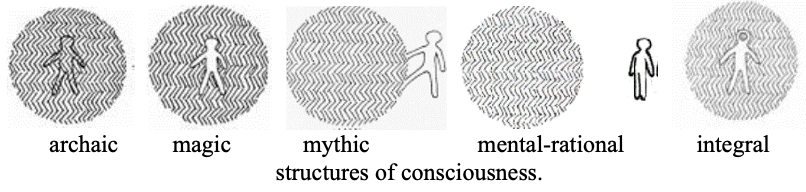
Integral
Connect and relate to the earth/universe in a new WAY. archaic magic mythic mental-rational integral
Evolution and Involution?
Moral-Integrity – Integral-Morality
The Journey today
Planetary
Emergence of what one could call Moral-Integrity and Integral-Morality/Moralogy?
How about GENIUS: Global Ethical Network for an Integral Universal Society?
Characterized by an Ethos of geniality, cordiality, friendliness.
And characterized through
Intensity, Union, Communion.
Experiencing the Ever-Present Origin
Prae-ligio beyond re-ligio.
(Compare: Divinized Future, https://www.genius-for-all.de/florilegium.php)
Path-Segment: Byung-Chul Han - Sensible Chaos
I’d like to close up with some Imaginations of a German Philosopher – with Korean roots – Byung-Chul Han. He shows us that our Vita Activa has to be complemented by a Vita Contemplativa which allows to become open for a new ‘Empire of Peace’. This Empire is quite similar to our today’s World. At the same time world changes a little bit.
Han refers to Novalis when he writes:
“In this world things are tangent to each other and permeate. Nothing is isolated for itself. Nothing abides in itself. Nothing holds one’s own. No fixed frontiers separate things from each other. We also can say: They become friendly to each other. Their friendly smiling frees the brace of identity. They flow into each other and intermingle. The world blazes in a friendly confusion into the ‘sensible Chaos’.
According to Novalis, this ‚friendly mess‘ (freundliches Durcheinander) announces a Future Society based on an Ethos of Cordiality (Ethos der Freundlichkeit), which eliminates isolations, divisions and alienations (Han, 2022, 117).
At the end again remembering President Hiroikes underlining the ‘age of mind and life’, Han intensifies what might change:
“In the coming Empire of Peace Man and Nature reconcile. Man is nothing more as a Fellow Citizen in a Republic of the Vivid (Mitbürger in einer Republik des Lebendigen), to which belong also plants, animals, stones, clouds and stars.” (Han, 2022, 118)
There are different cultures on this Globe to realize this Coming Empire of Peace. They have to come into dialogue attracted by the call out of the future. The Hiroike Institutes and the Moralogy Foundation Sections are an outstanding place and impulse-giver for such dialogues. And isn’t it now the moment to let the ‘kairos’ not to pass by and loose its crucial opportunity?
My apology
I was brought to the Hiroike Gakuen in 1971 – I am brought today, 2023, again to this Place.
Arigato for your open-mindedness and patience to listen or to view to such ‘hypotheses‘ of the different statements above.
Semimasen for my ego-centred attitude and the imposition to follow such Paths of Thoughts.
Path-Searcher
I am still continuing to try to make it better, following T.S. Eliots’ plea:
“In the newly emerging Integral structure (again, arriving on its own developmental schedule), time will function in a different way: no longer as a duration, but as an intensification, revealing a whole new depth and dimensionality to what was previously perceived merely as a flat surface. In this additional depth and coherence, Origin can finally present itself as what it truly has been all along—immediate, originary presence—not because God finally decides to show up, but because our vehicle of perception has matured enough to “bear the beams of love” without being fried alive.” (https://wisdomwaypoints.org/2021/02/the-faces-of-time-exploring-jean-gebser-lesson-xi/) (Accentuations by myself)
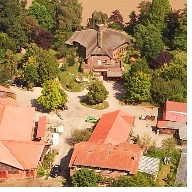
Enfolded in such a sphere, Dieter Scharmer (93) – Esther-Hatsumes’ father-in-law -, founder of the demeter bio-dynamic farm of Hof Dannwisch (https://www.dannwisch.de/),
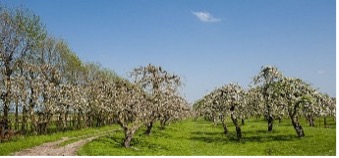
his elder brother Joachim Scharmer (95) from the demeter bio-dynamic Fruit-Hof Sommerland (https://obsthof-scharmer.de),
Jochen Pajunk, (86) former Protestant Priest and retired Priest of the anthroposophical Christian Community and I, as the youngster (82), meet ones a week for talking and reading – mostly Rudolf Steiner (Compare Bernard Lievegoed, ‘The Battle of the Soul’, Lighthouse 5, https://www.genius-for-all.de/florilegium.php). We believe in, we are aware of and we know, that morphic fields enclose what we are talking and sharing in such way around us and all over the Globe – besides online activities. How exciting it would be to meet and connect through such platforms in a permanent dynamic exchange of Vita Activa and Vita Contemplativa.
Don’t you think: Let’s do?
Born every day anew for a fresh start following –
the Toki too – the Call out of the Future.
Let’ start!
Part II:
'Living and dying in the whole, in integrity' (Jean Gebser)
Introduction
Dear participants in the Dialogue-Meeting on April 4th 2023, I want to thank you once more deeply for the coming together and the open-minded exchange of thoughts and experiences – though in retrospect I feel I was talking too much myself, taking you the chance to get a word in edgewise. Maybe I was on the one side a bit excited and on the other side I couldn’t tune adequately into a free spoken short and dense summery. But these days I’m not used to meet people in this way. I’m sorry for this behaviour .and I hope I can ‘repair’ it through ‘continuing the Draft’ and through our continuous exchange and communication.
The following passages – as ‘Part II’ – are again using Paul Klee’s picture of ‘Main path and byways’ as a symbol for combining different levels of information: Literature, scientific statements, imaginations and intuitions, cultural engraved experiences, pictures and foto-collages and other ‘strange’ perceptions – because ‘old man’ are allowed ‘moving into another intensity. For a further union, a deeper communion…” (T.S. Eliot). The different accentuations are done by myself!<
‘Listening back’ into the group I hear the following comments or contributions: Theory U was touched, especially its practicability; Goethe was mentioned in the context of Kairos and Chronos ("To the moment I'd like to say: 'Stay awhile, you are so beautiful'"); there came a hint about the symbol of the Labyrinth and the role it can play for life; Asahide Gakuen was questioned (http://www.asahide.ac.jp/english/) My ‘good, old friend’ Professor Bantock asked - looking at the end of the Paper and responding the request ‘Let’s start’-:
“What can I do?”
A legitimate question. ‘Ironically’ I’ll respond to it in a quite ‘theoretical manor’, following a remark of Joseph Beuys - the late German avant-garde sculptor and performance artist -: “Before I ask ‘what do I have to do’ I have to ask ‘how do I have to think’?”
So, doing and thinking will be treated in the following remarks in the way as the double helix movement does: Unifying ‘doing and thinking’ while polar moving and unifying.
And there is another question of Mr. Kinoshita, Jyoko around the phenomenon of
“Burnout”.
Because I couldn’t spontaneously answer in a proper way, I try to deal with this challenging situation here from my point of views. It will be not easy to find a way to this phenomenon, similar what may happen in your real life. There is perhaps the roof in your house or its fundament where water penetrates, more or less strong. You should stop it. But where might be found the source of the leak? Do you have to pitch of many places? How much of the roof you have to dig?
The questions coming up in our meeting may be treated 2023 not similar as 1971/72, when the ‘Kenkyubu-meeting’ started with exchanging ideas which have been important for us, reading texts we thought might be interesting and helpful to understand the daily study problems and experiencing all personally through the life at university and generally in the Gakuen.
As in the first Paper - Part I -I don’t want to miss the hint that I am looking very one-sided from outside. I am not anyhow involved in the ‘reality’ of the institutions, the economic, social and cultural policy of running them and the experiences of so many people being dedicated to the Idea and Daily Practice of Morality! Considering these limitations, I want to beg you for accepting my trials as my humble approach to questions which don’t only move you in the Hiroike Gakuen but which are global – not to say universal – and which contribute to the situation that this world won’t be destroyed.
In my figurative language or pictographic way of ‘thinking’. there is the ‘Tatsu’ and the ‘Mirror View’.
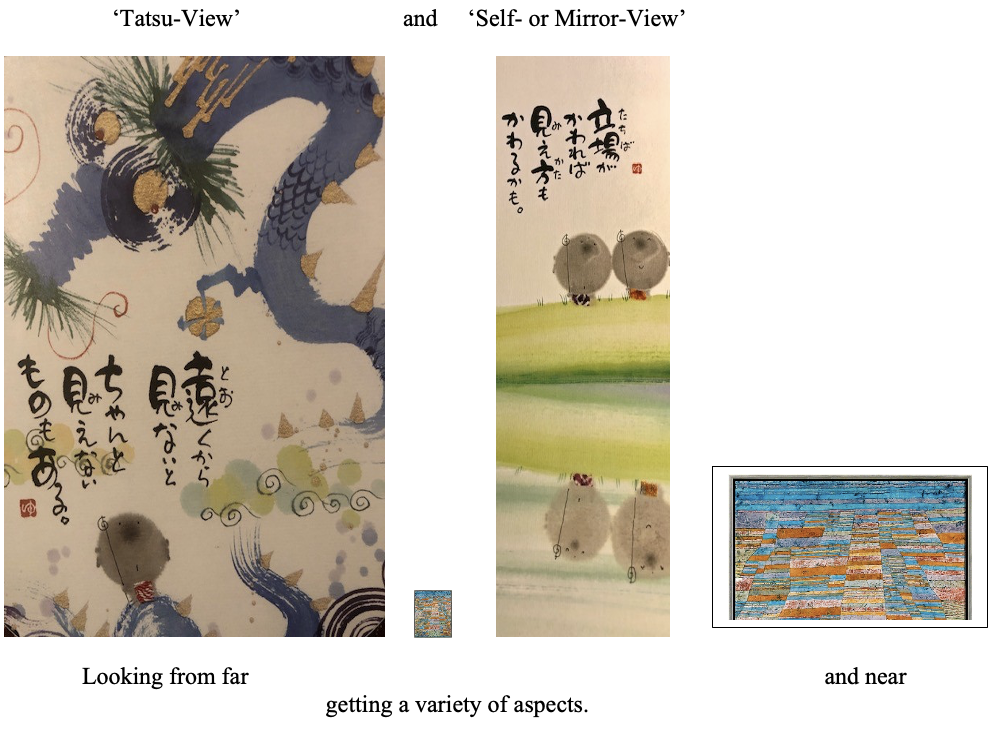
Hiroike Campus 2023’
Utterly the Tatsu-View becomes aware of this green Oasis in midst of an ocean of houses. But the Oasis seems to be much more cut through a Road and separated in two parts as ever before. The side with the Faculty of Economy and the place under construction seems more vivid than the other one with the main gate to the buildings of The Institute of Moralogy, the big Lecture Hall, the Place for Adult Education, the sports and high school facilities and last but not least the Campus Plaza.
This time ‘Guardsmen’ – but not like those at the entrances of temples – ‘give the impression’ of control and close off of free and uncomplicated approach.
The central locality for meeting, resting and staying, the Campus Plaza, seems to be closed and not any more the ‘Plaza or Piazza’ where public life happens. Are these ‘only the traces of the Covid-Pandemic?’
But there is also the ‘Self- and Mirror View’ which asks for looking closely and creating actively Path-Segments for an ‘Emerging Future’ – sometimes using a Lens to become aware of man and things in an enlarged viewing.
Paul Klee’s
‘Main path and byways’
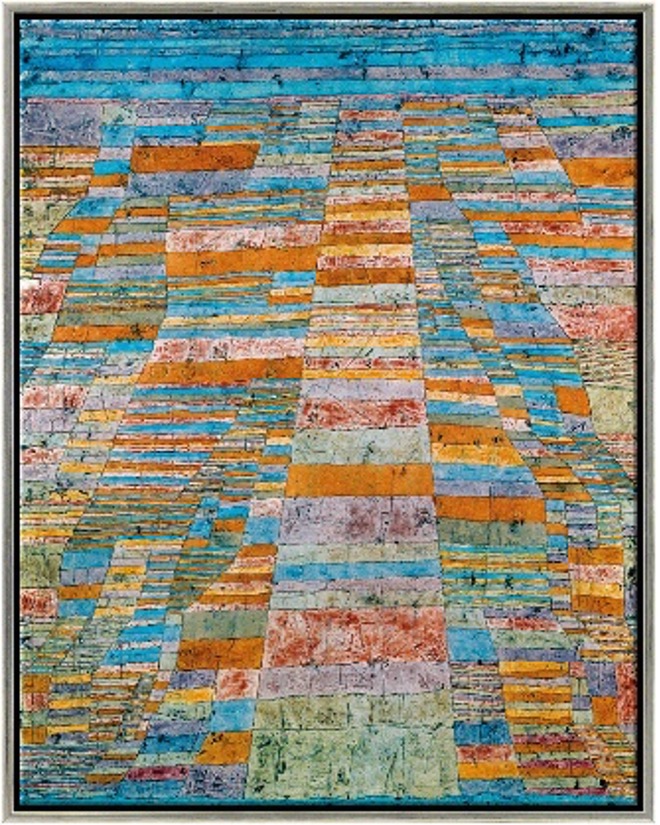
‘Main path and byways’ differently symbolize life in its wholeness, human activities, ways of dealing with a theme and so forth. Therefore, I will ‘step in’ in this painting again creating different ‘Path Segments’.
But also here again: Everybody’s free turn to negotiate one’s own way with it – or not.
The questions coming up in our meeting may be treated 2023 not similar as 1971/72 when the ‘Kenkyubu-meeting’ started for me with exchanging ideas which have been important for us at that time, in our age – around end of 20th beginning of 3oth, reading texts we thought might be interesting and helpful to understand the daily study problems, and experiencing all personally through the life at university and generally in the Gakuen.
How is the situation today, what could I discern when – supposed - in 2023 I’d like to engage in the same compassionate way as 1971, but now Elliot’s call to be ‘explorer’ and to ‘intensify, unite bring in communion what appeared in half a century’ carrying with me the influence of many different path-segments and now becoming aware of different website-messages.
Looking to the Websites of Presentations of Reitaku University and the Moralogy Foundation one is giving a manifold insight in the status at present of these institutions and how they are going to develop. What one becomes aware are dynamic movements and changes.
Reitaku University
About the Reitaku University one can read:
“…in today’s world of various problems and challenges… (Reitaku University) will be reborn as a comprehensive university that can respond to the era of ‘becoming an evolving university without fear of change’.”
(https://page.line.me/875cylfx/signboard/579439101639960).
President Tokunaga articulates the importance of Reitaku University in yet more passionate terms when he writes:
“Through educating students and producing young men and women of promise who embody ‘the idea of unity of knowledge and virtue,’ Reitaku University, which ‘sticks to its small-size,’ and ‘sticks to internationality,’aspires in the years to come to emerge as an institution for which the world and its regions have been waiting.” (https://www.reitaku-u.ac.jp/en/about/presidents-message/).
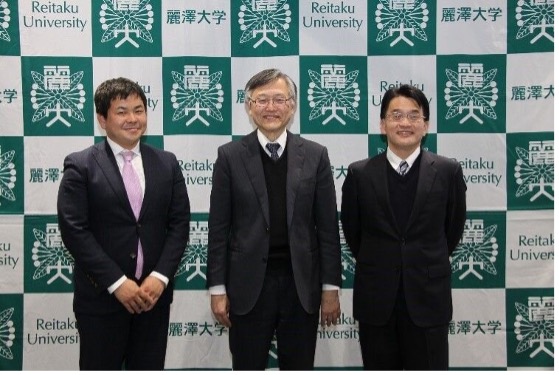
Koshio, Atsushi – Tokunaga, Suminori - Watanabe, Shin
(https://www.reitaku-u.ac.jp/news/news/1776170/
In March 2022 the Tokyo University of Foreign Studies (TUFS) announced “the outline and future prospects of the ‘Comprehensive University Concept that integrates humanities and sciences’ through the establishment of the Faculty of Engineering and the Faculty of Business Administration to respond to the development of human resources required by society.
(https://www.reitaku-u.ac.jp/en/about/presidents-message/)
But there is mentioned – just incidentally on this website - the aim which makes one sit up and take notice:
“Transformation into a new normal university”
How does these two directions fit together:
An Institution ‘for which the world is waiting’ and the aim of ‘a new normal university’?
Moralogy Foundation
The Institute of Moralogy transformed to Moralogy Foundation. The Website (https://eng.moralogy.jp/research/moralogy-research/) offers a detailed insight into a wide research and practical working field.
The new named ‘Moralogy Foundation’ mentions the following ‘Aims of the Research Center for Moral Science’:
• To inherit the will of Chikuro Hiroike
• conduct research activities with the aim of constructing a universal morality or a common morality that can be shared by all human beings, transcending religions and ideologies
• study of the principles of the human spirit and social structure from a comprehensive standpoint
• emphasize the values that human beings, society, and nations should have
• build an international research network in ethics and morals by deepening exchanges with researchers and research institutions both inside and outside Japan.” (https://eng.moralogy.jp/research/ ).
An Imagination comes up:
I ‘see’ a Bright Torch
in Chikuro Hiroikes Right-Hands-Fist
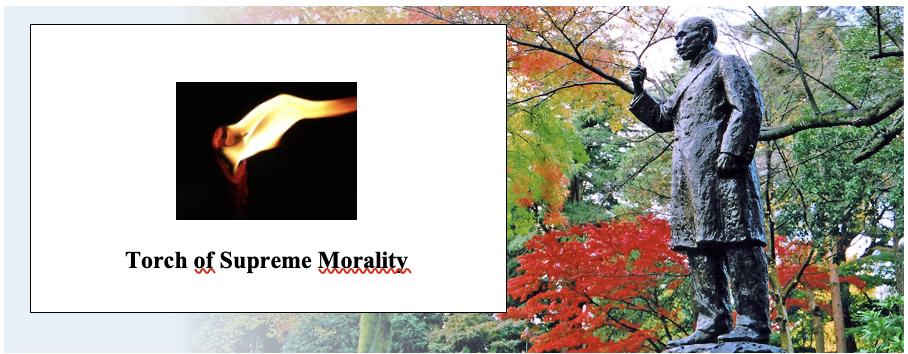
And I ‘hear’ Chikuro Hiroike saying:
‘Follow the Torch’
But I hear him also saying – not least in consideration of Mr. Kinoshita’s question about Burnout -
‘Spark the Inner Fire always anew!’
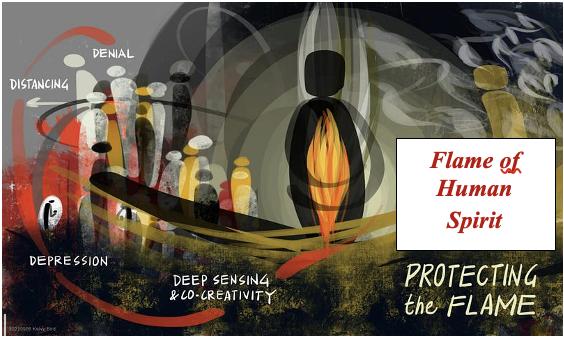
(Just published newly under https://medium.com/presencing-institute-blog/protect-the-flame-but-where-the-danger-is-the-saving-power-also-grows-ef6077ddef89)
The background of combining the ‘Torch’ and the ‘Inner Fire’ may be inspired by Otto Scharmer – but I feel also remembered to Inamori, Kazuo. In Scharmers ideas coming up in September 2022 while participating in the ‘World Ethic Forum (WEF)’ in Davos he takes up an experience of his student days related to Joseph Beuys. Scharmer explains:
“Joseph Beuys ‘Protect the Flame’
…So back to the big question: Are we sinking or are we going to rise? In my view, the answer depends on whether or not we try to, and succeed in, creating new types of social learning infrastructures for transformation – infrastructures that connect to and activate this human capacity for individual and collective transformation.
At the World Ethic Forum, the first two days started with a small holding circle of about 50 people, who were referred to as firekeepers. When it was my turn to share, I talked about a moving moment from my student days. I had watched Joseph Beuys accept the Wilhelm Lehmbruck Prize for sculpture in 1986. It probably was the last public was the last public speech Beuys gave, shortly before his passing. He spoke about the flame of inspiration Lehmbruck had provided for Beuy’s entire artistic body of work. He closed his speech with the words, ‘Protect the Flame!’ – Schütze die Flamme! These words struck a deep chord.
In that moment I felt as if that small flame, that represents the essence of human spirit, completely depends on people like us who receive it, protect it, and then pass it on to the next generation. When Beuys ended his speech with that line – Protect the Flame! – I felt as if I too had just received the flame, perhaps in a similar way as he did many years earlier… What I saw with my inner eye looked more like a candle: you hold the candle in one hand, and you protect the flame with the other – by holding it very close to your heart.”
‘…by holding it very close to the heart.’
Otto Scharmer: https://www.clubofrome.org/blog-post/scharmer-protect-the-flame/) (This week ‘Awakin Call’ from April 15th with the topic ‘Politics and Heart’- https://www.awakin.org/v2/talks/661/ - is showing into a similar direction.
Doesn’t Inamori, Kazuo’s ‘Compass to Life’ deal with such a Flame too? (Iwao, Taka -Learning Inamori Philosophy –
(https://www.reitaku u.ac.jp/news/images2/2020/06/LearningInamoriPhilosophyJapansMostInfluentialSocialPhilosophy.pdf)
Inamori: “The right way to live" and "how we should behave as human beings." It expresses the universal truth of life necessary for each of us to live in a better way. (https://global.kyocera.com/inamori/philosophy/main03.html)
Iwao Taka, Business Ethics, A Japanese View
A summery says: Although “fairness” and “social responsibilities” form part of the business ethics agenda of Japanese corporations, the meaning of these terms must be understood in the context of the distinctive Japanese approach to ethics. In Japan, ethics is inextricably bound up with religious dimension and social dimension. The normative environments, influenced by Confucianism, Buddhism, and other traditional and modern Japanese religions, emphasize that not only individuals but also groups have their own spirit which is connected to the ultimate reality. The framework of concentric circles lets moral agents apply different ethical rules to the respective circles. The dynamics of these religious and social dimensions lead to a different view of both individuals and corporations from that dominant in the West. (https://philpapers.org/rec/TAKBEA).
What might happen if Taka, Iwao would read with his students and lecture to them for example in the same way as about Inamori the ‘Ever-Present Origin’ of Gebser? Could this become another answer to Bantocks question ‘What can I do?’
Wouldn’t it be also a great chance – with the support of Taka Iwao – to read in a smaller circle of Reitaku and Moralogy Foundation scholars, staff and students together such a Treatise? - How about to create such a Circle of Firekeepers in the Hiroike Gakuen?
Are these not answers on the question: What can I do?
These remarks may consequently induce a Path-Segments fixed in the following way:
Path-Segment of Reitaku University and Moralogy Foundation
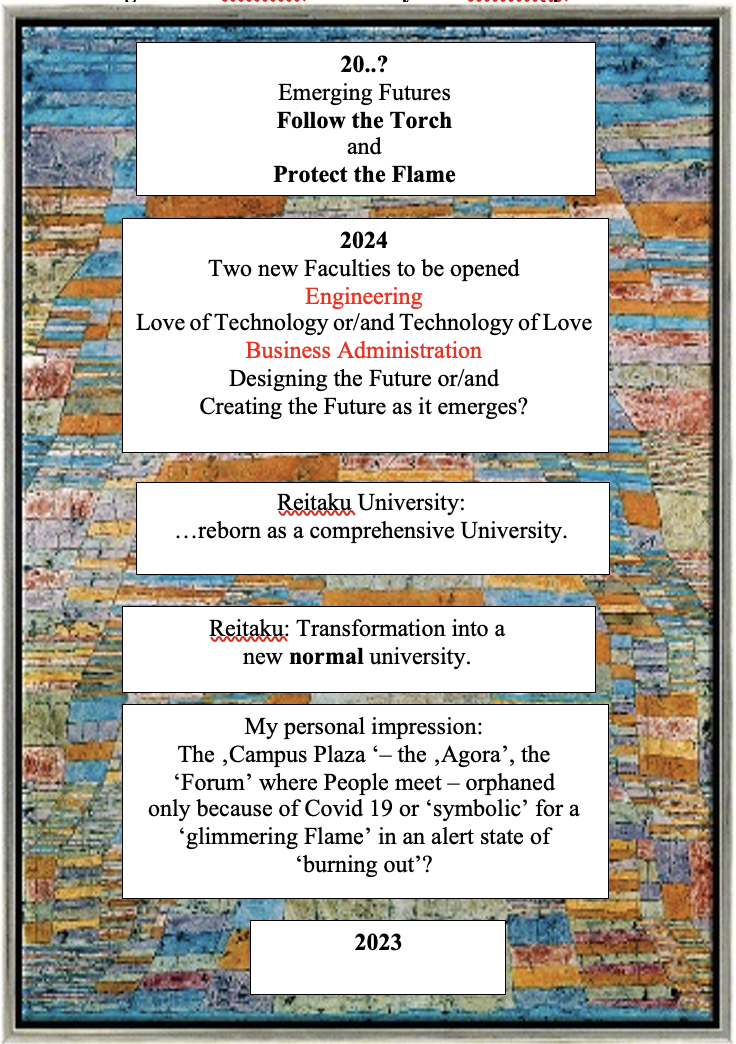
Wouldn’t it be also a great chance – with the support of Taka Iwao – to read in a smaller circle of Reitaku and Moralogy Foundation scholars together such a Treatise? Would there be a field of commitment for the elder generation in translating the German and English version of Gebsers ‘Ursprung und Gegenwart’, ‘The Ever-Present Origin’ beginning with selected chapters? - Another answer of the question: What can I do?
What could the symbols of the ‘Torch’ and the ‘Flame’ want to express?
The Figure of the Statue with the imagined ‘Torch’ and the inspiration of ‘Holding and protecting the Flame’ stand somehow ‘polar’ to each other. Are both pols – similar to the double helix – unified in Chikuro Hiroike Personality and Opus Magnus? And if not, shouldn’t they be seen in this unity?
Hiroikes Work is based on the fundaments of religious leaders of this world and he struggled to build up on these ‘platforms’ a Science based on the mental condition of man. The outcomes are realized through the theoretical frame of Moralogy, especially what is called ‘Supreme Morality’.
The ‘Torch’ symbolizes the aim of inheriting the will of Chikuro Hiroike.
In other words:
How would the will of Chikuro Hiroike looks like today in 2023?
giving the expressed demands the possibilities
• for Constructing a universal morality or a common morality
• for the study of the principles of the human spirit and social structure from a comprehensive standpoint
• for to emphasize the values that human beings, society, and nations should have
• build an international research network in ethics and morals by deepening exchanges with researchers and research institutions both inside and outside Japan.”
The question arises:
How to become open to these approaches to ‘morality’, ‘human spirit’, ‘values and the chance of ‘deepening exchanges…inside and outside Japan”!
Reading about Scharmers experience with the Flame - ‘holding it very close to the heart’ - guide to the question of the Relatedness of Chikuro Hiroike to one of those initial points I discovered in Otto Scharmers Theory U.
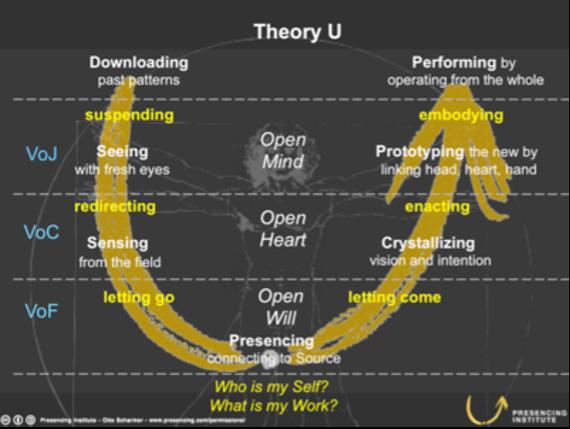
Theory U as I understand it isn’t a mistakeable understood ‘theory’ – but a ‘Way of Living!’ This WAY is characterized through an open mind and an open heart as swelling force of human’s open will. And before finding the strength of the will, man has to pass the eye of the needle, experience – similar as in Hiroikes view – as Martin Buber makes the distinction between two types of will: “…the small will, or one’s instincts, and the Grand Will, which is the future that needs us to come into reality. There is something deeply magical about tapping. Into our deeper creative force…” (Scharmer, 2007, 412)
I feel that the hint “to inherit the will of Chikuro Hiroike” shows in a similar direction. To ‘inherit’ surely doesn’t mean to ‘follow blindly’. Hiroikes call ‘Everyone has to be born daily anew’ shows which challenge for each Individuum Supreme Morality contains.
In Scharmers U-Movement passing the ‘eye of the needle’ includes an analogue ‘procedure’. Expressed with the last verse from Johann Wolfgang von Goethe and his poem ‘Selige Sehnsucht’:
For if this you do not grasp:
Perish and become!
The dark earth you shall walk
As a sullen one.
(https://en.wikipedia.org/wiki/Theory_U)
I don’t want to enter now in a profound discussion of Theory U – understood as a ‘holographic theory’. It would need much space and a detailed configuration. An attempt for which is now not enough space and time.
But, could the phenomena open mind, open heart and open will and their provoking dynamic be an interesting approach ‘to study of the principles of the human spirit and social structure from a comprehensive standpoint as, as Tokunaga, Suminori underlines?’
The Hiroike Gakuen is an exceptional Space and Place for Reitaku Lecturers and Moralogy Foundation’s Research Circles to use these advantages:
• “Places and infrastructures that facilitates shared seeing and sense-making of what is actually going on in the larger surrounding ecosystem (co-sensing),
• Places and cocoons of deep reflection and silence that facilitate deep listening and connection to the source of authentic presence and creativity, both individually and collectively (co-presencing),
• Places and infrastructures for hands-on prototyping of new forms of operating in order to explore the future by doing
(co-creating).
(Theory U, 2007, p. 44).
When Tokunaga, Suminori finishes his Message as follows: “Reitaku University, which “sticks to its small-size,” and “sticks to internationality,” aspires in the years to come to emerge as an institution for which the world and its regions have been waiting”, in the first moment one has to draw a deep breath: The world and the region have been waiting?!
Regionally viewed Tokunaga is right because the ‘Places’ are given at the: University, the Moralogy Foundation and its Branches all over Japan and region-connections near the Campus. Infrastructures – if not yet given – should and could be developed.
Scharmers article: Education Is the Kindling of a Flame: How to Reinvent the 21st-Century University” might contain helpful hints (https://www.researchgate.net/publication/327288052_Education_Is_the_Kindling_of_a_Flame_How_to_Reinvent_the_21st-Century_University
But how about Professor Tokunaga’s vision: ‘The world is waiting’?
Isn’t Tokunaka’s statement completely ‘hyped up’? Or does he sense – perhaps unconsciously - something to come if you don’t look only from the ‘Mirror view’ on ‘actual given ‘trends’ but from the flying Tatsu heights which allow to overview time and space.
What happens respective what – perhaps surprising - ‘outcomes’ develop when looking to the two new planed Faculties at Reitaku University from these two views?
Two stories are going to illustrate these views. One Jean Gebser mentions about Dschuan Dsi illuminates from the Mirror-view (but somehow also from the Tasu-view). Otto Scharmers remarks about AI could be seen as from the Tatsu-view (but also as from the Mirror view).
2024 two New Faculties are going to be opened
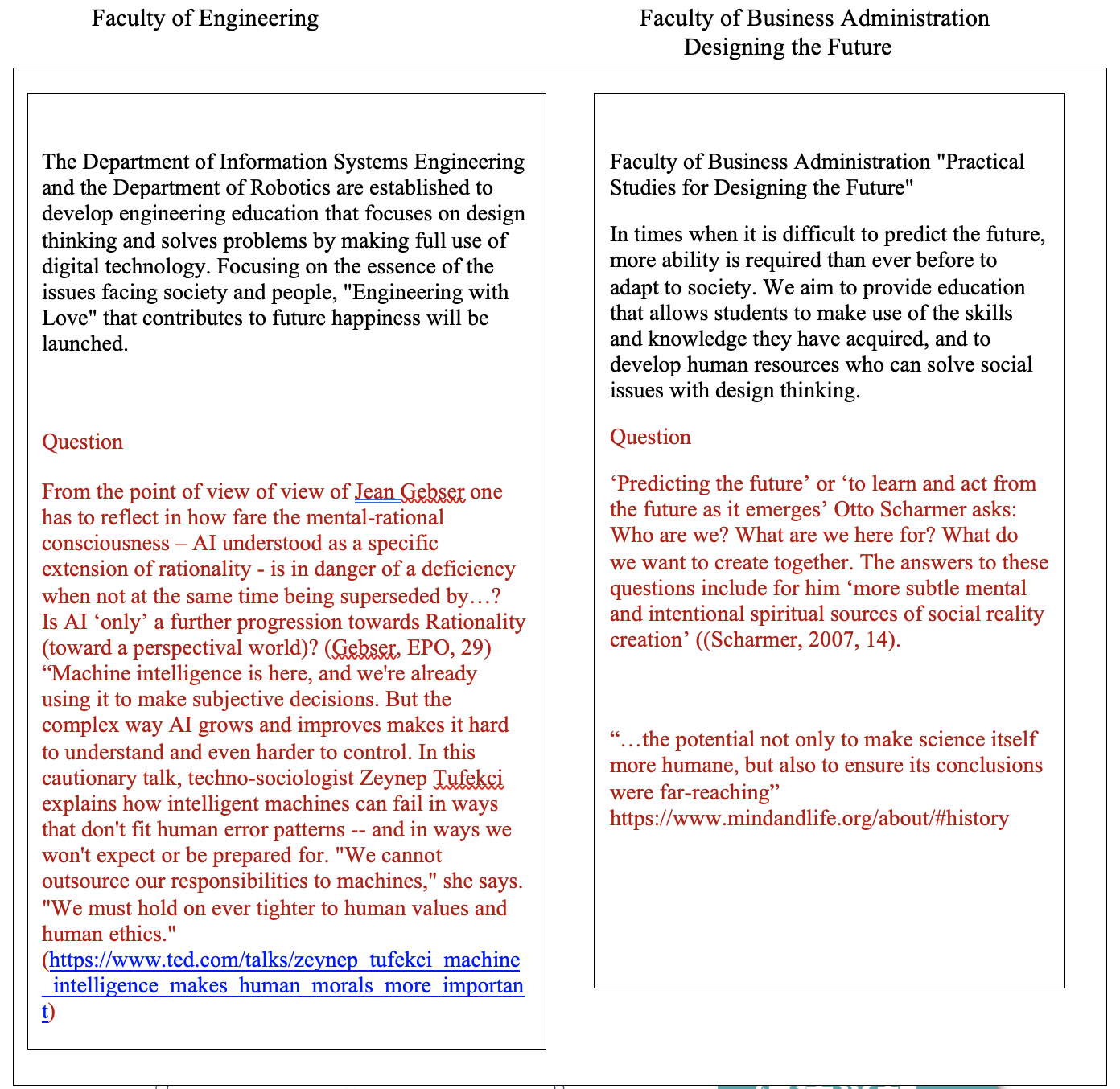
Path-Segment: Faculty of Engineering
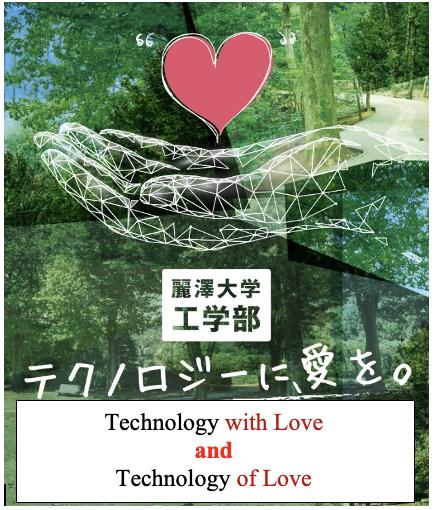
Motto: Love (of) Technology, Technology with love
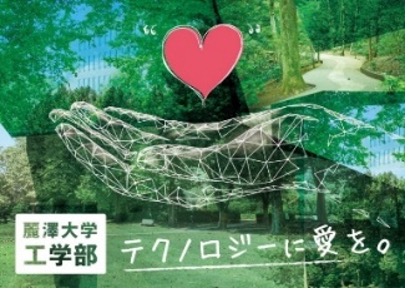
Symbolizing how the heart – organ of Love – is safely protected and carried from a ‘technologic weave through open hand
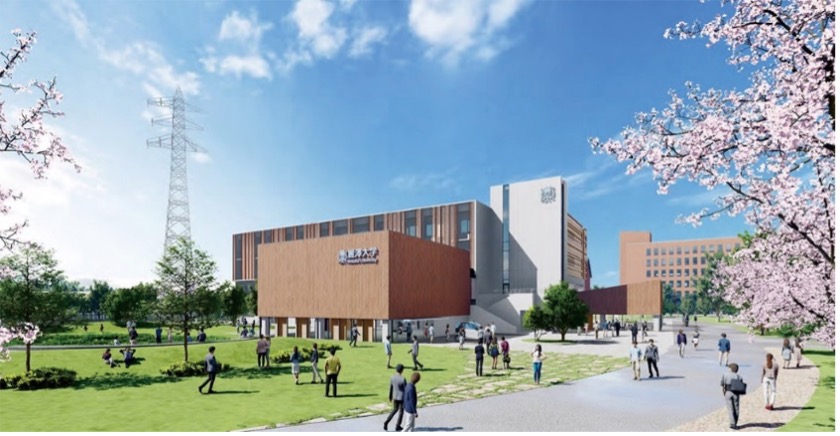
Illustration: Reitaku University Faculty of Engineering building planned
(https://www.reitaku-u.ac.jp/lp/engineering/)
A Story of Dschuang Dsi
Dschuang Dsi: “The drawing well”
”Dschi gung.was roaming in the State Tschu and afterwards returning to the State Dschin. While passing the region north of the river Han, he noticed an old man, being busy in his vegetable garden. He cut a roadside ditch for irrigating. He stepped down by himself to the well and carried up with his arms a pot full of water which he poured out. He struggled extremely but achieved little. Dsi Gung spoke to him: ‘There is a mechanism, with which you can water hundred trains in one day. With less arduousness much can be won. Won’t you like to use it?’
The gardener straightened up, looked to him and replied: ‘And what would that be?’ Dsi Gung answered: ‘You take a wooden lever arm, which is backside weighted and in front light. In this way you can ladle water so that it sputters. One calls this a ‘Drawing well’. The old man got a face like thunder and he answered laughing: ‘I heard my teacher saying: If somebody uses machines, all his business he does becomes mechanical; who does his business mechanical, he gets a Machine-Heart. But, if somebody wares a Machine-Heart in his chest, he loses the innocence of the heart. Who lost the pure innocence, he becomes ambiguous in the impulse of his mind (Geist). Insecurity in the Spirit doesn’t get along with the true Tao (the all-pervading divine World-Spirit). Not that I don’t know those things: I am ashamed to adopt them.’
Dsi Gung turned pink and became embarrassed. He looked down to the earth and didn’t respond.”
(Gebser, Verfall und Teilhabe (Decline and Participation), 1977, Collected Works Volume V/II, 19 ff.)
The Statement of Otto Scharmer in this context:
“…When you are talking to people in East Asia, in Silicon Valley, or elsewhere, AI of course is the topic of the moment. Does the deeper human capacity that I am describing here — the flame of our awakening planetary awareness and humanity — relate to the questions sparked by AI and ChatGPT? Yes, in every way.
AI and related language prediction machines like ChatGPT are brilliant at synthesizing (and mirroring back to us) the knowledge that we have accumulated thus far–in other words, the knowledge of the past. But what is it that these machines can’t do? They can’t do radical deep sensing. They can do sensing. But they can’t let go of predictions based on existing patterns in order to let come what wants to emerge from our deepest Source. In other words: They can’t do deep sensing. They can’t sense from the Source, from the future that wants to emerge. They can’t create from nothing, ‘no-thing’. That’s the ‘blind spot’ of AI.
And that’s what should be the single most important focus of our educational systems going forward: building the deep capacity to co-sense and co-create the future as it emerges. That’s what in Theory U we call presencing — the capacity to sense and act from the highest future in the now, in the present moment.”
Does the following graphic correspond to what Scharmer describes or is there a quite different idea in it?
“The word robot is derived from the Czech word "labor" and was conceived as a substitute for human labor.
However, even if we take "Doraemon" as an example, the definition of the word "robot" is no longer as applicable.
Let's learn, think, and create the "loving robots" of the future together!”
(https://www.reitaku-u.ac.jp/lp/engineering/)
Is this the meaning/sense of ‘Love Technology’, of creating ‘loving robots?
This would be a sad ‘one-sided spiral’ navigating this New Faculty in a ‘normal University’ which offers only more of the same but not of what ‘the world is waiting’!?
How might the double spiral provoke to ‘explore’ – as old men do – the Complementary Polarity of ‘Technic of the Inner World’ and ‘Technic of the outer World’? The first Treatise Jean Gebser published is titled ‘Abendländische Wandlung’ (Transformation of the West) where he speaks about a Complementarity of Occidental and Asiatic Technical Views.
How could the other pol look like? It is:
‘Technology of Love’ or ‘Technology with Love’
An Analogy may help to approach this question: ‘Technology of Love ‘comes in my mind through the experience of SEKEM (https://sekem.com/en/index/).
SEKEM’s ‘Economy of Love’ - based on an Islamic Background - is a New Label for Holistic Sustainable Production– understood as a holistic frame which includes that mind, heart and will are guided from an “‘Ego-free, Ecological’ Humanity”.
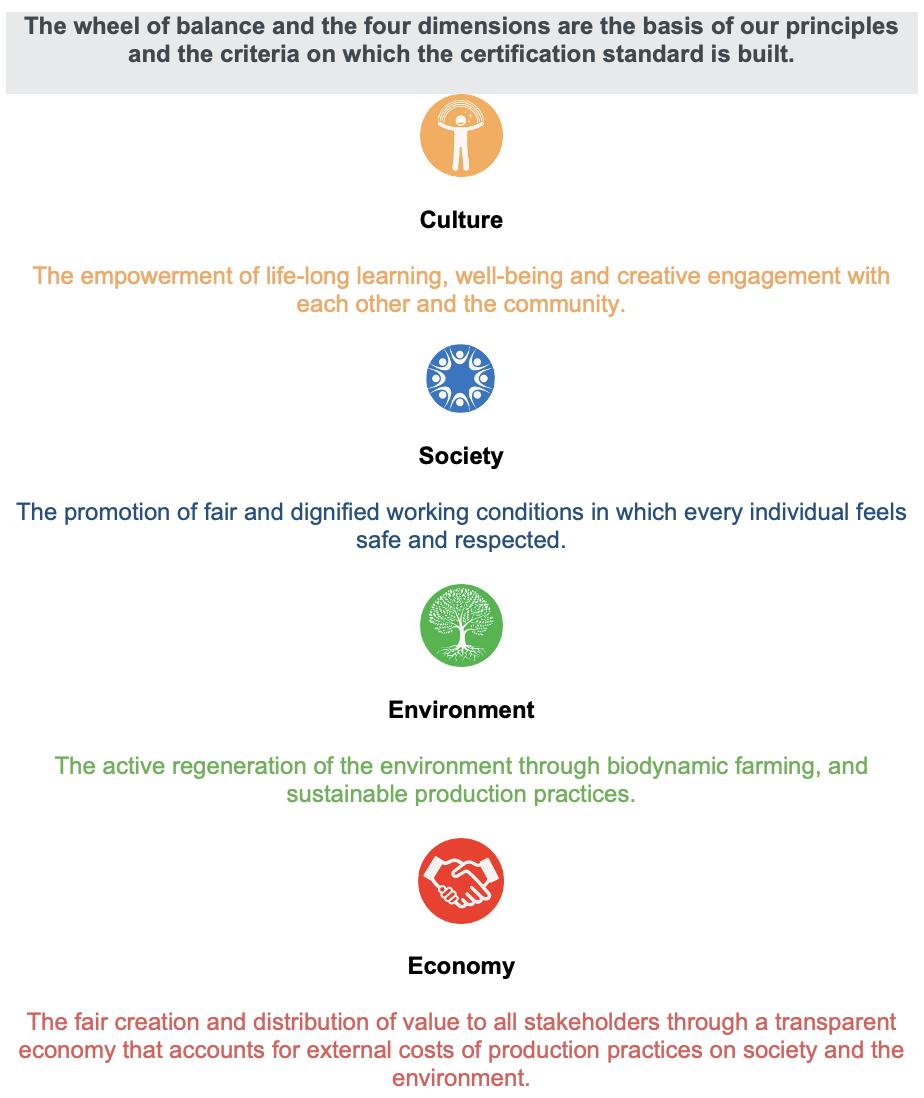
Wouldn’t it be worth to discuss this analogy from ‘Economy of Love’
https://www.economyoflove.net/, to approach a ‘Technology of Love ’or ‘Engineering of Love’?
Does SEKEM and the creation of the Label ‘Economy of Love’ and the Transfer to a ‘Label Technology of Love’ include hints for students, which Tokunaga means when talking about ‘to nurture the authentic ability of students and to provide them with a wider range of assets through offering specific programs across the three faculties’ and soon now five?
(https://www.reitaku-u.ac.jp/en/about/presidents-message/).
Is it conceivable that Reitaku University creates a New Label for Holistic Sustainable Studies:
Technology of Love?
Combined in the movement of the double spiral:
TECHNOLOGY WITH LOVE AND TECHNOLOGY OF LOVE
Technology of Love is not the same as Technology with Love or Love Technology. But they should not be seen ‘dualistic’ but ‘polar’.
Once more repeated: Reading about the “Slogan: ‘Transformation into a New Normal University’ - via the ‘Reitaku Standards’ in a Comprehensive university that integrates the humanities and sciences - ‘Love Technology/Engineering’ fits quite well. Expanding the field of Educational-Technology (EdTech) it is understandable to use ‘digital technology, including AI and robots, to change the way education works’, to use ‘data to quantify how much an individual has grown from university entrance to graduation.’ These are ‘belongings’ to a “new ‘normal’ university”. But are they essentially something else as ‘more of the same as given in other normal universities?
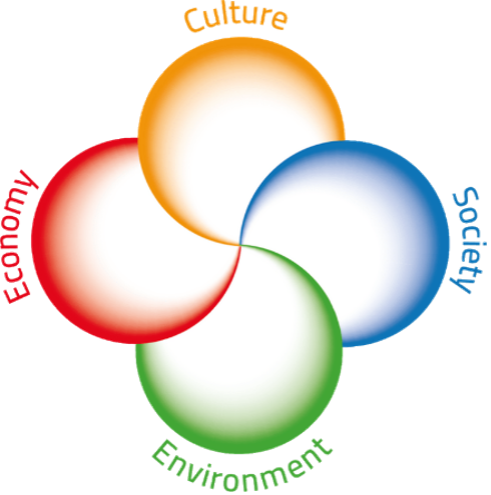
But how about a university ‘for which the world and its regions have been waiting? ‘Technology of Love’ seen through the lens of The Wheel of Balance between Culture, Society, Environment and Economy might become a Lable of Studies which follows an open mind and open heart and strengthens an open will crucial for one’s own life, society, the world and the universe.
‘Love’ – speaking out this word let be hesitant just to ‘use’ intellectually. Modifying the verdict of Chikuro Hiroike ‘Its’s easy to say, easy to do, but hard to be truly sincere’ it similar with Love: “It’s easy to say, easy to do but hard to live truly ‘out of Love’.” ‘Out of Love’ includes dimensions transcending bigger Self. It has to do also with the ‘Grand Will’ Buber mentions.
At least ‘out of Love’ encompasses the four dimensions and vice versa at least these dimensions are the soil to let think and act ‘out of Love’.
Wouldn’t it be worse to start a Research work about these polarities:‘with’ and ‘of’? It could be done in close connection with the fifth Faculty, the main task ‘Designing the Future’ and the Impulse of a Transformation/Mutation of Human’s Consciousness. – A further answer to the question: What can I do?
Path-Segment: The Faculty of Business Administration - Practical Science to Design the Future
Looking from the ‘Tatsu-View’ there is a phenomenon just emerging at the time when Chikuro Hiroike published his Opus Magnum the ‘Treatise on Moral Science’. 1927 Martin Heidegger published the book ‘Being and Time ‘(‚Sein und Zeit’) and 1916 Albert Einstein made his ‘General-Relativity-Theory’ public speaking about the unity of Time and Space. The Quantum Theory was revealed. Psychoanalysis and Psychosomatic found attention and in practical fields arose researches and efforts of ‘theoretical translation’.
It was in 1931 that Jean Gebser got his Inspiration about what he later worked out in his oeuvre ‘The Ever-Present Origin’, which “…’an emergent integral milieu’ coming out of the midst-twentieth century” (Johnson, 2019, 8)
May it be allowed that see Hiroike, Chikuro’s work in the context of such ‘an emergent integral milieu’? The phenomena of ‘Selflessness’ and the ‘Supreme Morality’ – just to mention these two – are they seeds out of this milieu?
Jeremy Johnson mentions: “Gebser’s time, I believe, has come yet: to help us in this age of existential and ecological crisis to think towards a planetary future.
Or, we might better say: to help us recognize how the future is already thinking us” (Johnson, 2019, STW, 12).
So,
designing the future and to recognize how the future is thinking us,
is that the question?
…superseding the sorrow of ‘merely surviving’?
We are also here confronted with the choice: Design or let emerge. The future is present and can inform us (STW, 172) - Homo faber is replaced by homo integer (STW, 171), Vita active by vita contemplative (Byung-Chul Han).
Does the consequence read:
“A Widened or mutated Consciousness for a Faculty of Business Administration.”
Creating the Future as it Emerges?
To get into this act would – similarly to the act ‘Thory U – needs a wide range of extending the main Thoughts and Roots of Jean Gebsers work, especially ‘The Ever-Present Origin’. ‘Pictured summarized’ one can express the ‘History of Awakening the Consciuosness’ – the main theme of Gebser – with the ‘Tatsu-View’ - as follows:
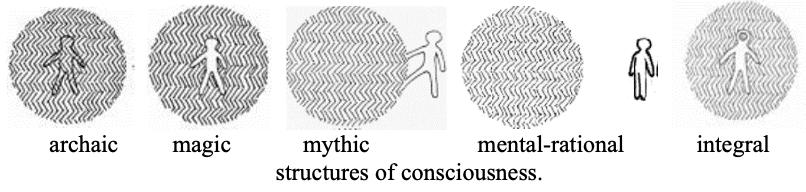
The integral consciousness supersedes all others, but doesn’t destroy them! It is named: a-perspective, a-rational, time-free. Characteristics not easy to understand, concretize and share. Man, and his relation to the world mutates or transforms to the ‘task’
Waring the world.
Waring the Integral World.
Connect and relate to the earth/universe in a new WAY.
Can this be understood as a Motto for a Global Cooperation and Exchange?
The Hiroike Gakuen a Place for ‘Waring the World’?
How to combine it with the Torch of Hiroike and the Flame of the Ever-Present Origin?
Only a few keywords without detailed interpretations
Evolution and Involution?
Moral-Integrity – Integral-Morality
The Torch gets another intensity of its flame.
It lights towards Planetary:
Jeremy Johnson interpret it using the film ‘Neo-Tokyo by Otomo, Katsuhiro, 1988’
(Johnson, 2019, STW, 149).
Is there Emergence of what one could call Moral-Integrity and Integral-Morality?
How about GENIUS: Global Ethical Network for an Integral Universal Society?
Characterized by an Ethos of geniality, cordiality, friendliness.
Characterized through
Intensity, Union, Communion.
Experiencing the Ever-Present Origin
Prae-ligio beyond re-ligio.
(Compare: Divinized Future, https://www.genius-for-all.de/florilegium.php)
For the Reitaku University and the Moralogy Foundation – being waited globally and regionally – this might be the task, the challenge and the destiny – under the guidance of its President Hiroike, Mototaka – to contribute in the future to come answers to this transformation.
We are not lost.
Waring the World.
Reitaku University and Moralogy Foundation giving Space for a
Integral Morality
for a
Lived Ethic in Presence!
Creating “…Institutions for which the world and its regions have been waiting…
in the years to come!
(https://educativ.net/universities/japan/reitaku-university)
Last views to the Hiroike Campus 2023 once more from the altitude where the Tatsu is flying and from the Mirror experience while entering through the main Campus Gates.
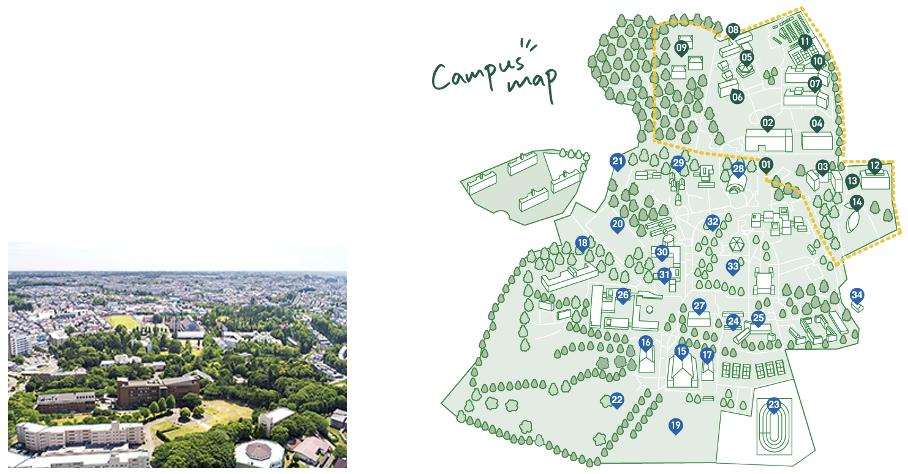
Looking from far in the first moment one doesn’t become aware, that the Hiroike Campus – geographically viewed – is ‘split’. There is a road which ‘cuts’ the campus in two parts. One may say an east and west part. Only a small overhead crossing – besides the zebra-crossing on the dividing street – links the two areas. One also could risk the analogy of the brain, which is a holistic organ of two parts: Separated without separateness.
Coming from the direction of the ‘Campus living area Hokobu’, the ‘left side’ of the University ‘with the new Faculty Buildings under construction – ‘seems’ to be more ‘vivid or busy’ as the right big ground.
Looking near, the modern Guardsmen at the Gates or Building entry (for example building 03 of the map) – not similar to those niō (benevolent kings) at the entrance of Buddhistic Temples - appear as if the ‘inflow’ should be controlled and regulated because of…?
Primal Trust
Quoting Jeremy Johnson:
“In a talk hosted in 1972, ‘Primal Fear and Prima Trust,’ Gebser considers this inquiry of origin (‘Where do I come from?,’ ‘Who am I?,’ and ‘Whither do I go?’) ads a singularly important set of questions concerning the integral human being:
So long as we do not find an answer to those questions, primal fear reigns. From it springs, to the degree that we become aware of those questions, the diverse creaturely, psychic, and intellectual anxieties. It is also in the last analysis the trigger for aggression and depression…which can lead to destruction of others or of oneself. Only he who finds an answer to these questions awakens primal trust and thus is freed from primal fear. What is most incomprehensible is that in tis case he will have overcome the primal fear forever and is therefore not threatened by any relapse into it.” (Johnson, 2019, STW, 167 ff).
Roots of Burnout?
Final thoughts
The gift of President Hiroike, Mototaka to come to the Reitaku University as a ‘Visiting Professor’ let come up many thoughts. The theme which guided me these last months couldn’t be responded sufficiently: How to combine Heaven and Earth. Is it because we are living in a time of transition? The following pictures or imaginations, coming out of the above mentioned ‘integral field’ will accompany me and I am thankful for their appearance.
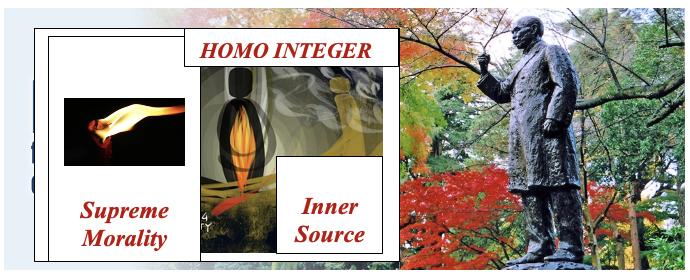
Jean Gebser, the person who escorts and guides me on the ‘Main Path’ of my Life, closes the chapter about the ‘Foundation of the Aperspectival World’ in ‘The Ever-Present Origin’:
“If an integral man were to encounter a deficient mental man, would not deficient mental power fail in the face of integral strength? Would not the individual ego-consciousness falter in the face of Itself-consciousness of mankind? the mental-rational in the face of the spiritual? fragmentation in the face of integrality?...
…Man is in the world to sustain it as well as himself ‘in truth’, not for his or for its own sake, but for the sake of the spiritual present. It is this spiritual present which elevates wholeness to transparency and frees us from our transient age, for this age of ours is not the present but partiality and flight (Flucht), indeed, almost a conclusion (Ende). Only someone who knows of Origin has present (Gegenwart) – living and dying in the whole, in integrity.”
(Gebser, EPO, 1984, 273)
Publications
Selected Literature in English
Gebser, Jean: The Ever-Present Origin, 1984, Ohio University Press, Athens, Authorized Translation by Noel Bastard with Algis Mickunas
Hiroike, Chikuro: Towards Supreme Morality, 2002, The Institute of Moralogy, 3 Volumes, Kashiwa
Hiroike, Chikuro: The Characteristics of Moralogy and Supreme Morality, New Revised Edition 1966
Jaworski, Joseph: Synchronicity, The Inner Path of Leadership, 2011, Berrett-Koehler Publisher, San Francisco (CA)
Jaworski, Joseph: Source, The Inner Path of Knowledge Creation, 2012, Berrett-Koehler Publisher, San Francisco (CA)
Johnson, Jeremy: Seeing Through the World, Jean Gebser and Integral Conciousness, 2019, Revelore Press, Seattle (WA)
Kadowaki, Kakichi: Erleuchtung auf dem Weg. Zur Theologie des Weges, 1993, Kösel Verlag München. (Japanese Original: Michi no Keijijo-gaku, 1990, Iwanami Shoten, Tokio)
Scharmer, C. Otto: Theory U, Leading from the Future as It Emerges, 2007, Cambridge (MA)
(There is a translation in Japanese ‘U-Riron’, 2010, Eiji Press)
Scharmer, C. Otto: The Essentials of Theory U, Core Principles and Applications, 2018, Berrett-Koehler Publishers, Oakland (CA)
Scharmer, C. Otto, Kaufer, Katrin: Leading From the Emergent Future, From Ego-System to Eco-System Economies, Applying Theory U to Transforming Business, Society, and Self, 2013, Berrett-Koehler Publishers, San Francisco (CA)
Senge, Peter, Scharmer, C. Otto, Jaworski, Joseph, Flowers, Betty Sue: Presence, Human Purpose and the Field of the Future, 2004, Cambridge (MA)
The Institute of Moralogy: An Outline of Moralogy, A New Approach to Moral Science, 1987, Kashiwa
The Institute of Moralogy: Chikuro Hiroike, Father of Moralogy, 2005, Kashiwa
German Publication
Han, Byung-Chul, Vita Contemplativa, 2022, Ullstein, Berlin
(Translations in English from this Publication in German)
Klostermann, W.U., Ochiai, Ryoichi: Moralogie, Dotoku-do, Ein Japanischer Weg Praktizierter Moral Aufgrund der Lehren von Grossen Weisen, 1996, Fischer, Herausgegeben vom Moralogie Institut Kashiwa
Links
Jean Gebser Society USA: https://gebser.org/
Jeremy Johnson: jeremy@nuralearning.com
Otto C. Scharmer: https://www.u-school.org/; https://presencinginstitute.org/
YouTube Presentations in English.
|